The Mobile Coffee Group
Watch as a story
Tap either side to skip, hold to pause, or expand for a bigger view. Arrow keys work too.
Something else
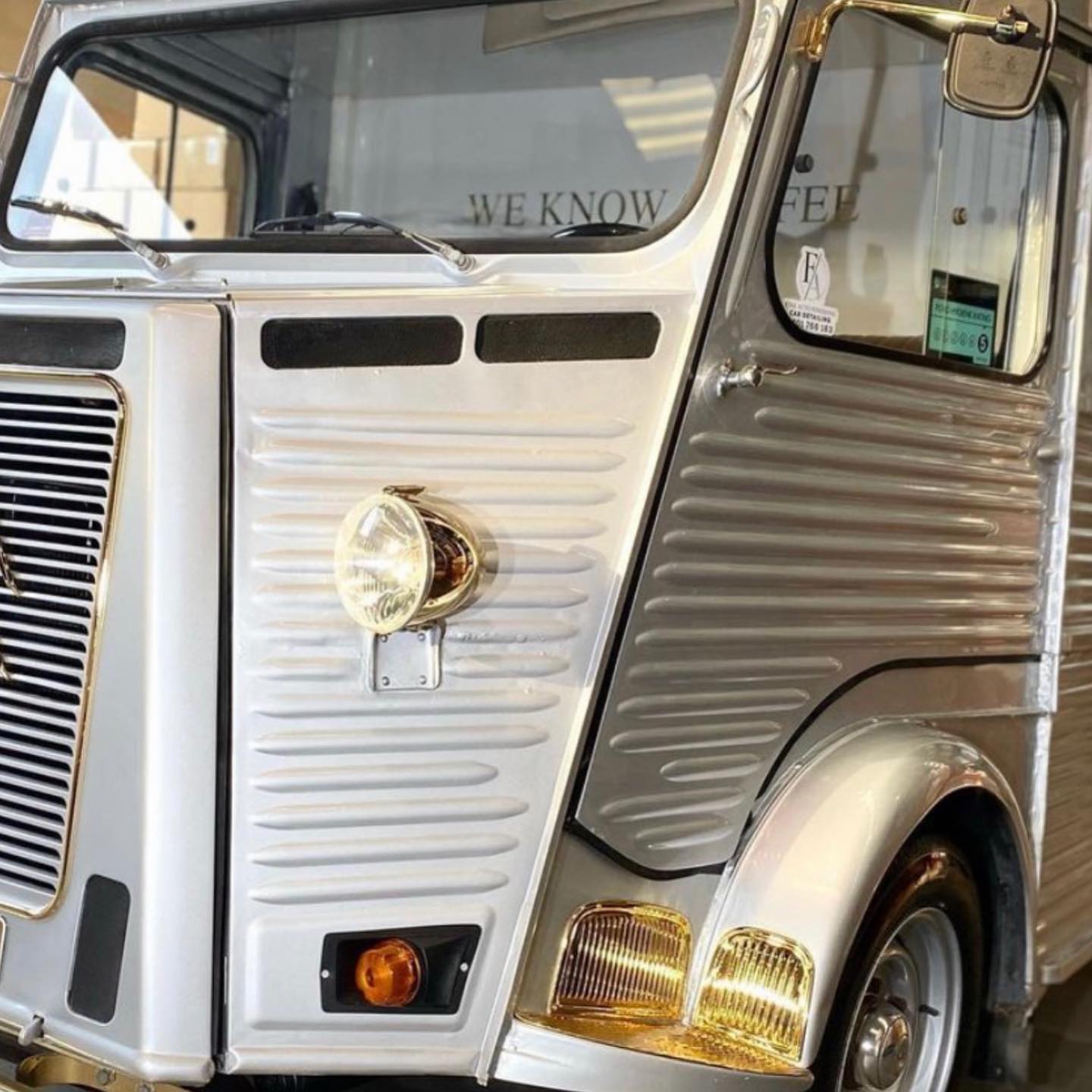
Not every build starts with a van, a ute or an Ape. A restored Citroën HY, a box truck wrapped edge to edge in custom graffiti art — if it can carry a machine and a grinder, we'll fit it out to the same standard as everything else in the range.
See the gallery How it's built
Unusual bases, custom finishes and one-off builds — click through the clips in the main window, or pick one from the strip below.
The Mobile Coffee Group
Watch as a story
Tap either side to skip, hold to pause, or expand for a bigger view. Arrow keys work too.
What we've built
Every shell on this page skips the standard checklist and gets assessed on its own terms. Two things carry across all of them regardless: enough internal volume for a real servery, and a chassis or restoration in good enough condition to certify for the road.
A Citroën HY, a VW Kombi, or anything else with real character — restored to a standard that carries the brand, then fitted out behind the scenes with the same equipment as any modern build.
A box body gives more usable volume than almost anything else on this page — room for a full servery, seating storage, or a second work zone, all inside one enclosed shell.
Where the vehicle itself is the brand statement — full graffiti art, hand-drawn characters, wraps that cover every panel — the fit-out goes in after the wrap is designed, not before.
A classic shell needs the same roadworthy and food-safety sign-off as anything else we build — often more involved, since the chassis and wiring get restored as part of the job.
Some of these are built to be the centrepiece at weddings and brand activations rather than trade daily on the street — the fit-out still runs a full machine, just tuned for how the vehicle actually gets used.
If it's not a van, a ute, an Ape or a truck, that's exactly what this category is for. Send us what you've found and we'll tell you what it takes to fit it out.
Build your own
The same five decisions as every other build, but nothing is assumed. A restored shell brings its own structural questions before layout is even on the table; a full custom wrap moves branding to the front of the process instead of the back.
A Citroën HY's low cab and curved roofline take a different bench shape to a box truck's flat walls. The layout gets drawn to the vehicle's own geometry rather than adapted from a standard plan.
Two-group machines are installed, either gas or inverter/battery powered. Paired grinders sit alongside, and the power choice follows the work — gas for long days away from a plug, inverter and battery where a quiet, flueless set-up matters.
On a classic shell, tanks and plumbing run through spaces that don't touch the panels or trim worth preserving. On a box truck, there's usually more freedom to route them wherever the layout wants.
A battery bank, inverter and modern wiring loom go in regardless of how old the shell looks from outside — the machine and fridge run on the same electrics as any current build.
Gold trim and a period-correct respray for a restored classic, or edge-to-edge custom artwork for a build that's meant to stop traffic — the finish is the first decision on this category, not the last.
Send your nearest dealer a photo of the shell you're thinking about and they'll tell you what it would take to fit it out.